whats the weather like to live in north carolina

Northward Carolina'south climate varies from the Atlantic coast in the eastward to the Appalachian Mountain range in the west. The mountains frequently act as a "shield", blocking low temperatures and storms from the Midwest from entering the Piedmont of North Carolina.[1]
Nigh of the land has a humid subtropical climate (Köppen climate nomenclature Cfa), except in the higher elevations of the Appalachians which have a subtropical highland climate (Köppen Cfb).
The USDA hardiness zones for the country range from zone 5a (-20 °F to -15 °F) in the mountains to zone 8b (15 °F to 20 °F) along the coast.[2] For most areas in the state, the temperatures in July during the daytime are approximately ninety °F (32 °C). In January the average temperatures range near 50 °F (x °C).[3]
| Building | Jan | Feb | Mar | Apr | May | Jun | Jul | Aug | Sep | Oct | Nov | December |
|---|---|---|---|---|---|---|---|---|---|---|---|---|
| | ||||||||||||
| Asheville | 46/26 | 50/28 | 58/35 | 66/42 | 74/51 | 80/58 | 83/63 | 82/62 | 76/55 | 67/43 | 57/35 | 49/29 |
| Greatcoat Hatteras | 54/39 | 55/39 | threescore/44 | 68/52 | 75/threescore | 82/68 | 85/73 | 85/72 | 81/68 | 73/59 | 65/l | 57/43 |
| Charlotte | 51/32 | 56/34 | 64/42 | 73/49 | 80/58 | 87/66 | 90/71 | 88/69 | 82/63 | 73/51 | 63/42 | 54/35 |
| Greensboro | 47/28 | 52/31 | 60/38 | 70/46 | 77/55 | 84/64 | 88/68 | 86/67 | 79/threescore | 70/48 | lx/39 | 51/31 |
| Raleigh | 50/thirty | 54/32 | 62/39 | 72/46 | 79/55 | 86/64 | 89/68 | 87/67 | 81/61 | 72/48 | 62/40 | 53/33 |
| Wilmington | 56/36 | 60/38 | 66/44 | 74/51 | 81/sixty | 86/68 | xc/72 | 88/71 | 84/66 | 76/54 | 68/45 | 60/38 |
Precipitation [edit]
In that location is an boilerplate of forty-5 inches of rain a yr (fifty inches in mountainous regions). July storms account for much of this atmospheric precipitation. As much as 15% of the rainfall during the warm flavor in the Carolinas can be attributed to tropical cyclones.[4] Mountains usually see some snow in the fall and winter.[1] Moist winds from the southwest drib an average of eighty inches (2,000 mm) of precipitation on the western side of the mountains, while the northeast-facing slopes boilerplate less than one-half that corporeality.[v]
| Average monthly atmospheric precipitation | |||||||||||||
| City | Jan | Feb | Mar | Apr | May | Jun | Jul | Aug | Sep | Oct | November | Dec | Full |
|---|---|---|---|---|---|---|---|---|---|---|---|---|---|
| Asheville[half dozen] | 2.6 inches (66 mm) | iii.one inches (79 mm) | 4 inches (100 mm) | 3.3 inches (84 mm) | 2.nine inches (74 mm) | 3.v inches (89 mm) | 3.4 inches (86 mm) | 4 inches (100 mm) | three.1 inches (79 mm) | ii.seven inches (69 mm) | 2.half dozen inches (66 mm) | 2.7 inches (69 mm) | 38.1 inches (970 mm) |
| Cape Hatteras[7] | 5.six inches (140 mm) | 4.1 inches (100 mm) | 4.6 inches (120 mm) | three.2 inches (81 mm) | iii.8 inches (97 mm) | four.two inches (110 mm) | four.9 inches (120 mm) | vi.4 inches (160 mm) | v.3 inches (130 mm) | five.3 inches (130 mm) | 4.nine inches (120 mm) | 4.v inches (110 mm) | 56.9 inches (i,450 mm) |
| Charlotte[8] | three.vii inches (94 mm) | three.vii inches (94 mm) | 4.6 inches (120 mm) | 3 inches (76 mm) | 3.6 inches (91 mm) | 3.five inches (89 mm) | 3.8 inches (97 mm) | 4.one inches (100 mm) | 3.3 inches (84 mm) | three.2 inches (81 mm) | 3.1 inches (79 mm) | 3.three inches (84 mm) | 43 inches (1,100 mm) |
| Greensboro[nine] | 3.3 inches (84 mm) | 3.iii inches (84 mm) | 3.8 inches (97 mm) | 3.2 inches (81 mm) | iii.six inches (91 mm) | 3.viii inches (97 mm) | 4.4 inches (110 mm) | 4.one inches (100 mm) | 3.3 inches (84 mm) | iii.4 inches (86 mm) | 2.nine inches (74 mm) | 3.2 inches (81 mm) | 42.3 inches (1,070 mm) |
| Raleigh[10] | iii.5 inches (89 mm) | 3.5 inches (89 mm) | 3.7 inches (94 mm) | 2.8 inches (71 mm) | 3.8 inches (97 mm) | 3.6 inches (91 mm) | four.four inches (110 mm) | iv.four inches (110 mm) | 3.i inches (79 mm) | 3 inches (76 mm) | ii.nine inches (74 mm) | 3.i inches (79 mm) | 41.8 inches (ane,060 mm) |
| Wilmington[xi] | 3.6 inches (91 mm) | 3.5 inches (89 mm) | iv.3 inches (110 mm) | 2.nine inches (74 mm) | 4.3 inches (110 mm) | 5.4 inches (140 mm) | 7.ix inches (200 mm) | 7 inches (180 mm) | five.six inches (140 mm) | 3.iii inches (84 mm) | 3.3 inches (84 mm) | 3.five inches (89 mm) | 55 inches (one,400 mm) |
Snowfall [edit]

Snow in North Carolina is seen on a regular footing in the mountains. North Carolina averages five inches (130 mm) of snow per winter season. However, this varies profoundly beyond the land. Along the coast, about areas register less than 2 inches (51 mm) per year while the state capital, Raleigh, averages vi.0 inches (150 mm). Further westward in the Piedmont-Triad, the boilerplate grows to approximately nine inches (230 mm). The Charlotte expanse averages approximately v.0 inches (130 mm). The town of Boone, North Carolina, located at an superlative of 3,333 anxiety in the northwestern part of the land, averages approximately 45 inches of snowfall per winter flavor.[ citation needed ] The mountains in the west human activity as a barrier, preventing well-nigh snowstorms from inbound the Piedmont. When snowfall does make information technology past the mountains, it is usually light and is seldom on the ground for more than two or three days. However, several storms have dropped 18 inches (460 mm) or more than of snowfall within normally warm areas. The 1993 Storm of the Century that lasted from March 11 to March fifteen affected locales from Canada to Fundamental America, and brought exceptionally heavy snowfall to North Carolina. Newfound Gap received more than than 36 inches (0.91 m) of snow with drifts more than 5 feet (i.5 m), while Mount Mitchell measured over iv feet (1.2 m) of snow with drifts to fourteen anxiety (4.three one thousand).[12] Most of the northwestern part of the state received somewhere betwixt 2 feet (0.61 m) and three feet (0.91 m) of snow.
Another meaning snowfall hit the Raleigh expanse in January 2000 when more than 20 inches (510 mm) of snow fell.[thirteen] There was also a heavy snowfall totaling 18 inches (460 mm) that hit the Wilmington surface area on Dec 22–23, 1989. This storm affected just the Southeastern The states coast, every bit far south as Savannah, GA, with little to no snow measured westward of I-95. About big snows that bear on areas east of the mountains come from extratropical cyclones which approach from the south across Georgia and South Carolina and move off the coast of North or South Carolina. These storms typically throw Gulf or Atlantic moisture over cold Chill air at ground level, usually propelled southward from Chill high pressure over the Northeastern or New England states. If the storms track sufficiently far to the e, snow volition exist limited to the eastern part of the land (as with the December 22–23, 1989 tempest, and the January 4, 2018 storm that dropped 4 inches at Cape Hatteras, but virtually no snow in inland North Carolina locations). If the cyclones travel close to the coast, warm air volition go pulled into eastern North Carolina due to increasing menstruation off the milder Atlantic Sea, bringing a pelting/snow line well inland with heavy snow restricted to the Piedmont, foothills and mountains, as with the Jan 22, 1987 storm that dropped 6 inches at Charlotte. If the storm tracks inland into eastern North Carolina, the pelting/snow line ranges between Raleigh and Greensboro.[14]
| Average monthly snowfall | |||||||||||||
| Urban center | Jan | Feb | Mar | Apr | May | Jun | Jul | Aug | Sep | Oct | November | December | Full |
|---|---|---|---|---|---|---|---|---|---|---|---|---|---|
| Asheville[6] | four.half dozen inches (12 cm) | 4.6 inches (12 cm) | three inches (7.half dozen cm) | 0.vii inches (1.8 cm) | - | - | - | - | - | - | 0.seven inches (1.8 cm) | 2 inches (5.1 cm) | xv.vi inches (twoscore cm) |
| Cape Hatteras[vii] | 0.four inches (1.0 cm) | 0.six inches (1.v cm) | 0.four inches (1.0 cm) | - | - | - | - | - | - | - | - | 0.6 inches (i.5 cm) | two inches (5.1 cm) |
| Charlotte[8] | 2 inches (5.1 cm) | ane.vii inches (iv.three cm) | i.2 inches (iii.0 cm) | - | - | - | - | - | - | - | 0.1 inches (0.25 cm) | 0.5 inches (ane.3 cm) | v.5 inches (fourteen cm) |
| Greensboro[nine] | 3.one inches (seven.9 cm) | 2.5 inches (6.4 cm) | i.7 inches (four.three cm) | - | - | - | - | - | - | - | 0.1 inches (0.25 cm) | 1.2 inches (3.0 cm) | 8.6 inches (22 cm) |
| Raleigh[10] | two.2 inches (five.6 cm) | 2.6 inches (6.6 cm) | 1.3 inches (three.three cm) | - | - | - | - | - | - | - | 0.one inches (0.25 cm) | 0.8 inches (ii.0 cm) | seven inches (18 cm) |
| Wilmington[11] | 0.4 inches (ane.0 cm) | 0.5 inches (ane.iii cm) | 0.4 inches (1.0 cm) | - | - | - | - | - | - | - | - | 0.6 inches (1.5 cm) | one.9 inches (4.8 cm) |
Tropical cyclones [edit]
| | This commodity needs to exist updated. The reason given is: Probably add more recent big hurricanes. (Feb 2020) |


Located along the Atlantic Declension, many hurricanes that come up up from the Caribbean Sea make it up the coast of eastern America, passing past Northward Carolina.

On October fifteen, 1954, Hurricane Hazel struck North Carolina, at that time it was a category iv hurricane within the Saffir-Simpson Hurricane Scale. Hazel caused pregnant impairment due to its strong winds. A weather station at Oak Island reported maximum sustained winds of 140 miles per hour (230 km/h), while in Raleigh winds of ninety miles per 60 minutes (140 km/h) were measured. The hurricane caused 19 deaths and significant destruction. I person at Long Beach claimed that "of the 357 buildings that existed in the town, 352 were totally destroyed and the other five damaged". Hazel was described as "the most destructive storm in the history of N Carolina" in a 1989 study.[15]
In 1996, Hurricane Fran fabricated landfall in North Carolina. As a category 3 hurricane, Fran caused a smashing deal of damage, mainly through winds. Fran'south maximum sustained wind speeds were 115 miles per hour (185 km/h), while N Carolina's declension saw surges of 8 feet (two.4 grand) to 12 feet (3.7 thou) above body of water level. The amount of damage caused past Fran ranged from $1.275 to $2 billion in North Carolina.[15]
Rain [edit]
Heavy rains accompany tropical cyclones and their remnants which move northeast from the Gulf of Mexico coastline, equally well every bit inland from the western subtropical Atlantic ocean. Over the by thirty years, the wettest tropical whirlwind to strike the coastal plain was Hurricane Floyd of September 1999, which dropped over 24 inches (610 mm) of rainfall north of Southport. Dissimilar Hazel and Fran, the main force of devastation was from precipitation. Earlier Hurricane Floyd reached North Carolina, the state had already received large amounts of pelting from Hurricane Dennis less than two weeks earlier Floyd. This saturated much of the Eastern North Carolina soil and allowed heavy rains from Hurricane Floyd to plow into floods. Over 35 people died from Floyd.[15] In the mountains, Hurricane Frances of September 2004 was most every bit wet, bringing over 23 inches (580 mm) of rainfall to Mount Mitchell.[16]
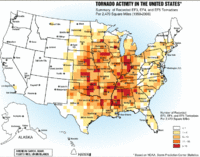
Tornado activity in the United States
Astringent weather condition [edit]
In well-nigh years, the greatest weather condition-related economic loss incurred in North Carolina is due to severe weather condition spawned past summer thunderstorms. These storms impact express areas, with their hail and air current accounting for an average annual loss of over US$5 million.[17]
Northward Carolina averages 31 tornadoes a year with May seeing the about tornadoes on average a month with 5. June, July and August all have an average of three tornadoes with an increase to iv boilerplate tornadoes a month in September. It is through September and into early November when Northward Carolina can typically expect to see that smaller, secondary, severe weather season. While severe weather flavour is technically from March through May, tornadoes have touched downwards in N Carolina in every month of the yr.[18] On November 28, 1988, an early on forenoon F4 tornado smashed across northwestern Raleigh, continuing 84 miles farther, killing iv and injuring 157.[19] On February half-dozen, 2020, severe storms hitting N Carolina, with a tornado kickoff in Rowan County, northward of Charlotte. as information technology travelled due north, current of air speeds picked up to 30 mph.[twenty] By 4pm, 100 000 people were without power and flash alluvion warnings were striking areas in the North and Northwest with this floodwatch staying in full result until the following Th.[twenty]
Changes [edit]
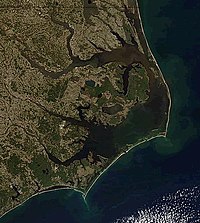
The North Carolina coastline is expected to rise betwixt one and iv feet in the adjacent century due to a combination of warming oceans, melting ice, and land subsidence.[21] Temperatures in North Carolina accept risen. Over the last 100 years, the boilerplate temperature in Chapel Hill has gone up ane.2 °F (0.7 °C) and precipitation in some parts of the land has increased past five percent.[22] Around the year 2080, "temperatures are probable to rise above 95°F approximately 20 to 40 days per year in nigh of the state, compared with nigh 10 days per twelvemonth" in 2016.[21]
Seasonal conditions [edit]
Winter [edit]
In wintertime, North Carolina is somewhat protected past the Appalachian Mountains to the westward. Cold fronts from Canada are typically reduced in intensity by the mountains. However, occasionally common cold air can movement from the due north or northeast, east of the Appalachian Mountains, from Chill high pressure systems that settle over the Northeastern or New England states. Other polar and Arctic outbreaks can cross the mountains and force temperatures to driblet to about 12 °F (−11 °C) in central Due north Carolina. Still, temperatures beneath zero degrees Fahrenheit are extremely rare exterior of the mountains. The coldest ever recorded temperature in North Carolina was −34 °F (−37 °C) on Jan 21, 1985, at Mount Mitchell. The winter temperatures on the coast are milder due to the warming influence of the Atlantic Body of water and the Gulf Stream.[23] The average ocean temperature in Southport in January is still higher than the average body of water temperature in Maine during July.[23] Snow is mutual in the mountains, although many ski resorts apply snowmaking equipment to make sure in that location is e'er snowfall on their land.[23] Northward Carolina's relative humidity is highest in the winter.[23]
Bound [edit]
Tornadoes are almost probable in the jump. Major tornado outbreaks afflicted parts of eastern North Carolina on March 28, 1984, and Apr 16, 2011. The month of May experiences the greatest rise in temperatures. During the spring, in that location are warm days and cool nights in the Piedmont. Temperatures are somewhat libation in the mountains and warmer, particularly at night, near the coast.[23] N Carolina'due south humidity is everyman in the spring.[23]
Summer [edit]

North Carolina experiences high summer temperatures. Sometimes, cool, dry out air from the northward will invade North Carolina for cursory periods of fourth dimension, with temperatures rapidly rebounding.[24] It remains colder at high elevations, with the boilerplate summer temperature in Mount Mitchell lying at 68 °F (20 °C). Morning temperatures are on average 20 °F (12 °C) lower than afternoon temperatures, except along the Atlantic Coast.[23] The largest economic loss from severe conditions in North Carolina is due to astringent thunderstorms in the summer, although they normally merely hit small-scale areas.[23] Tropical cyclones tin can impact the state during the summer too. Fogs are also frequent in the summer.
Fall [edit]
Fall is the nearly chop-chop irresolute season temperature wise, peculiarly in October and Nov.[23] Tropical cyclones remain a threat until tardily in the season. The Appalachian Mountains are frequently visited at this time of year, due to the leaves changing colour in the trees.[23]
Southern Oscillation [edit]
During El Niño events, winter and early jump temperatures are cooler than average with above average precipitation in the central and eastern parts of the land and drier weather in the western function. La Niña usually brings warmer than average temperatures with above average precipitation in the western role of the land while the primal and littoral regions stay drier than average.
Run across also [edit]
- Climate
- Climate change
- Climatic change in North Carolina
- Climatology
- List of N Carolina hurricanes
- List of North Carolina conditions records
- List of wettest known tropical cyclones in Due north Carolina
- Meteorology
References [edit]
- ^ a b North Carolina Section of the Secretary of Country. North Carolina Climate & Geography. Retrieved on 2008-01-13.
- ^ "N Carolina USDA Constitute Hardiness Zone Map". plantmaps.com plantmaps. Retrieved Dec 12, 2018.
- ^ a b U.S. Travel Atmospheric condition. N Carolina Weather condition. Retrieved on 2008-01-13. Archived January 29, 2008, at the Wayback Machine
- ^ David B. Knight Robert E. Davis. Climatology of Tropical Cyclone Rainfall in the Southeastern United states. Retrieved on 2008-02-29.
- ^ City-Data.com North Carolina - Climate Retrieved on 2008-02-09.
- ^ a b Weatherbase. Asheville, North Carolina Weather. Retrieved on 2008-02-08.
- ^ a b Weatherbase. Cape Hatteras, North Carolina Conditions. Retrieved on 2008-02-08.
- ^ a b Weatherbase. Charlotte, North Carolina Weather. Retrieved on 2008-02-08.
- ^ a b Weatherbase. Greensboro, North Carolina Weather. Retrieved on 2008-02-08.
- ^ a b Weatherbase. Raleigh, Due north Carolina Weather. Retrieved on 2008-02-08.
- ^ a b Weatherbase. Wilmington, Northward Carolina Weather. Retrieved on 2008-02-08.
- ^ Intellicast.com. "MARCH IN THE NORTHEAST". Retrieved 2008-02-09 .
- ^ Environmental Modeling Center. EMC MODEL GUIDANCE FOR THE BLIZZARD of 2000. Retrieved on 2008-02-09.
- ^ Keeter, Kermit K.; Businger, Steven; Lee, Laurence G.; Waldstreicher, Jeff S. (March 1995). "Winter Weather Forecasting throughout the Eastern United States. Part Three: The Furnishings of Topography and the Variability of Winter Weather in the Carolinas and Virginia". Weather and Forecasting. 10 (1): 42–lx. Bibcode:1995WtFor..ten...42K. doi:x.1175/1520-0434(1995)010<0042:WWFTTE>two.0.CO;2.
- ^ a b c Country Climate Office of North Carolina. Inquiry on North Carolina Severe Atmospheric condition. Retrieved on 2008-03-09. Archived December xvi, 2005, at the Wayback Machine
- ^ Roth, David Chiliad; Hydrometeorological Prediction Heart. "Tropical Whirlwind Rainfall in the Southeastern United States". Tropical Cyclone Rainfall Point Maxima. The states National Oceanic and Atmospheric Administration's National Weather Service. Retrieved June 5, 2012.
- ^ Land Climate Office of Due north Carolina. Overview. Archived 2007-12-23 at the Wayback Motorcar Retrieved on 2008-03-14.
- ^ Ii Tornado Seasons In North Carolina | digtriad.com
- ^ Raleigh Tornado
- ^ a b Price, Mark (6 February 2020). "Storms, high winds, heavy rain through Triangle". The News & Observer . Retrieved 3 April 2020.
- ^ a b "What climate change means for Northward Carolina" (PDF). EPA. August 2016. Retrieved 28 February 2020.
- ^ Duke University. Climate Change and North Carolina Archived September 12, 2008, at the Wayback Machine Retrieved on 2008-01-17.
- ^ a b c d east f g h i j State Climate Office of North Carolina. Full general Summary of Due north.C. Climate. Archived 2007-12-23 at the Wayback Auto Retrieved on 2008-01-xiii.
- ^ NCDC Climate of North Carolina Retrieved on 2008-02-09. [ dead link ]
External links [edit]
- State Climate Office of N Carolina
Source: https://en.wikipedia.org/wiki/Climate_of_North_Carolina
0 Response to "whats the weather like to live in north carolina"
Post a Comment